
Oxford and the American Revolution
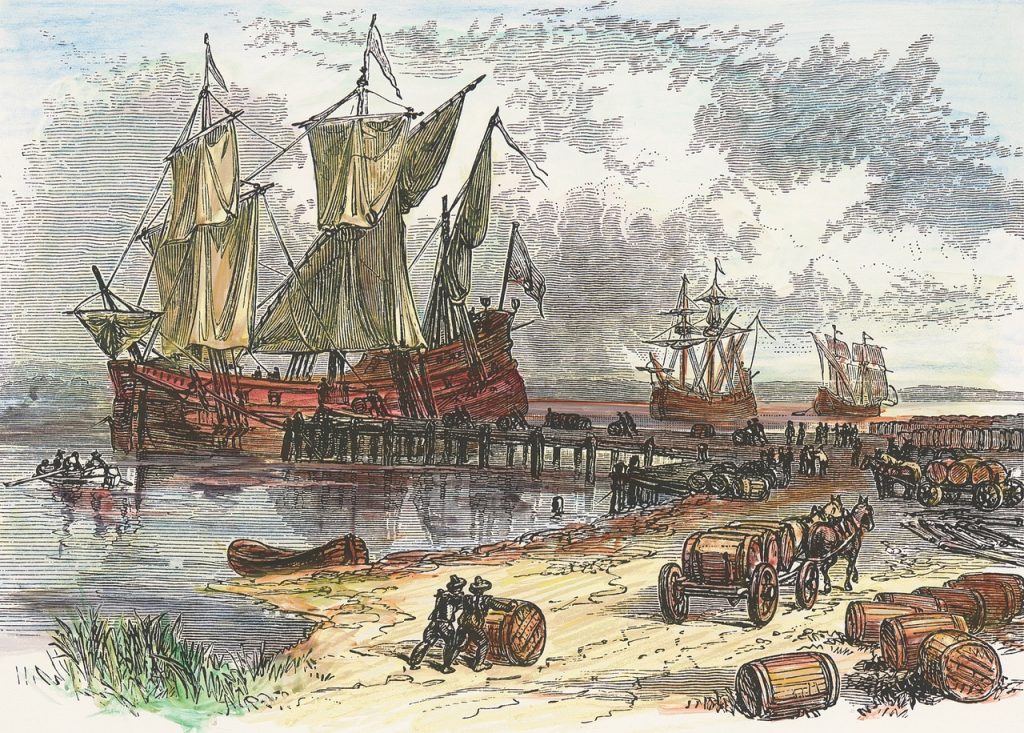
In the years leading up to 1776, Oxford operated as a legally designated
“port”, one of very few within the Maryland Colony. Its chief rivals in that respect
were Annapolis and Fells Point (later part of Baltimore) and, to a lesser extent,
Chestertown.
To be a port required designation as such by the colonial Maryland General
Assembly and assignment of government officials, often Naval officers, to manage
the customs record-keeping regarding ships and their cargoes, including most
specifically shipping manifests and the duties paid to the government. Ports
needed deep water for anchorage of ocean-going ships, warehouses for storing
goods exported and imported, and wharves and piers for loading and unloading
ships. They also had to have storehouses for provisioning of ships and some
facilities for repairing them. Finally, and not least important, they had to
accommodate to some extent the transient sailors, which meant taverns for eating,
drinking and entertainment.
Ports were mandated by the British government as a means of managing
overseas commerce in compliance with the British Navigation Acts. These acts
required that all imports and exports be handled by English ships and that specific
“enumerated” goods such as tobacco be funneled through ports in England or one
of its colonies. The intent was to minimize smuggling and maximize collection of
customs duties for the Crown. The actual commercial transactions were handled
through private trading companies that owned many of the facilities in the ports,
particularly the warehouses, as well as some of the wharves and piers.
The primary trading house in colonial Oxford was the Liverpool-based firm
of Foster Cunliffe & Sons. Until his premature death in 1750, this operation was
managed by Robert Morris, Sr., as chief factor. He was easily Oxford’s most
successful merchant. Morris oversaw Foster Cunliffe & Sons exports of tobacco,
pork, hides and lumber, as well as import of manufactured goods from England.
There were other factors from other British firms based in Oxford during this
period, but none were able to fill Morris’ shoes after he was gone. The port records
of ships and cargoes suggest that Oxford’s peak as a port was probably in 1750, the
year that Robert Morris died, and the falloff in cargo originations and landings
suggest a slow but noticeable decline in the succeeding quarter century.
The principal export from Oxford during this period was tobacco, which was
also used as a form of currency in transactions with the trading houses until about 1748.
Wheat was also grown by Eastern Shore farmers and by 1775 had begun to
overtake tobacco as the principal export in other places on the Eastern Shore such
as Chestertown in Kent County. But tobacco remained the principal export crop in
Oxford until the American Revolution, probably to its detriment, as we shall see.
The tobacco traded through the Port of Oxford was grown on plantations
located on the Chesapeake Bay side of the mid-Eastern Shore such as Talbot and
Dorchester counties. The land was relatively flat and there was generally good
water access to the Bay, which was important given that there were very few roads
in the area prior to the American Revolution and water transportation was the
principal means of getting around. Plantations near Oxford were generally large
aggregations of land and labor, sometimes including slaves, and planters built
themselves mansions such as Bonfield, Plimhimmon and Otwell in order to locally
oversee their operations. However, this meant that the Town of Oxford had few
permanent residents except the merchants, tavernkeepers and storekeepers who
actually lived there, which at least partly explains why Oxford today has few
structures with colonial-era roots.
The most prominent house in town at this time was the one on the present
site of the Robert Morris Inn. It was owned by Foster, Cunliffe & Sons and
occupied by its principal factor. It may be that portions of the existing structure of
the Robert Morris Inn incorporate elements of that dwelling.
Events Leading Up to the American Revolution
It is misleading to think of the American Revolution as something that just
happened in 1776 with the Declaration of Independence. If we analogize the birth
of the nation to its human counterpart, the gestation period of the independent
nation was decades in the making. With English settlement of the American
continent having begun in the early 17th Century, almost 150 years had elapsed by
the beginning of the French and Indian War in 1754. That is six or seven
generations, depending on the generational measuring rod, so there were many
American colonists by then who not only had had no personal memory of the
mother country, but no handed-down memories either.
Moreover, what Americans think of as “the French and Indian War” was not
a unique event. Rather it was part of a series of wars between the English and
French over several centuries, but in the 17th and 18th Centuries involved the
North American continent more specifically. The French and Indian War, known
globally as the Seven Years’ War, was from 1754 to 1763, and it turned out to be
both extensive and expensive for the British Crown, requiring fleets of ships and
the logistics of supporting troops in the field thousands of miles away from the
mother country.
After that war had concluded, the consensus but by no means unanimous
view within the English Parliament was that it was not unreasonable to require the
increasingly prosperous American colonies to bear some of the cost of their
defense. Accordingly, from 1764 onwards a number of new acts were passed with
the intent of raising revenue from the colonists. The first of these was the Sugar
Act of 1764 designed to crack down on smuggling as well as provide a stream of
tax revenue. This was followed by (1) the Currency Act (1764) that forbade the
colonies from issuing their own currencies; (2) the Stamp Act (1765) that forced
colonists to pay specific taxes on the issuance of legal documents, newspapers,
playing cards and pamphlets; (3) The Quartering Act (1765) that forced the
colonists to pay for food and lodging of British soldiers; and (4) The Townshend
Acts (1767) imposing tariffs on imports of glass, lead, paint, paper and tea. The last
of the new tax acts was the Tea Act in 1773 which imposed a specific tax on tea.
The colonists’ reaction to these increased taxes was anger and ultimately
outrage. It was the Tea Act that led to acts of open resistance such as the Boston
Tea Party in 1773. The prevailing sentiment was that the taxes were unfair
because, unlike British citizens who lived in England, there was no representation
of the colonists in Parliament. Without such representation, the taxes were
considered by the colonists to be illegitimate exercises of government authority.
Their collective outrage led the various different colonies, whose previous
experience with one another had been mostly to fight alongside the British in the
French and Indian War, to begin to build political bonds with their fellow colonists.
The early attempts took the form of Committees of Correspondence in the 1760s in
which views were exchanged by letter among emerging political leaders. After the
Boston Tea Party, Parliament responded in early 1774 with The Coercive Acts that
closed Boston Harbor. Maryland had its own response to that with the Annapolis
Convention in May of 1774 in which Marylanders pledged to cease trade with
Britain. On May 24, 1774, citizens of Talbot County issued a formal statement of
support for Boston in the form of a document that came to be known as the “Talbot
Resolve.” Other counties issued similar resolves.
By the middle of 1774, royal government of Maryland had ceased to
function. When the royal governor effectively suspended the operation of the
Royal Assembly, the assemblymen formed their own “extra-legal” assembly and
continued to meet, calling themselves the Convention of Maryland. This body sent
delegates to the First Continental Congress, which acted in October of that year to
establish a Continental Association to enforce a unified colonial embargo on all
trade with Britain. To enforce the embargo, counties across Maryland formed their
own Committees of Observation to keep watch on the ports, including Oxford.
As one of the largest and most active ports in Maryland, these events were
immensely important to Oxford. Its commercial reason for existence was directly
threatened. The boycott on importation of goods from Great Britain, Ireland and
the West Indies was made effective by the First Continental Congress on December
1, 1774. By its terms, the embargo on exports to those entities was to be made
effective September 10, 1775 if the Coercive Acts were not repealed.
On April 19, 1775, the opening battle of the Revolutionary War in Lexington
and Concord Massachusetts occurred. This breakout of open hostilities effectively
speeded up the timing of the embargoes and upended all operations of British ports
in the American Colonies, most especially Oxford.
What Happened in Oxford During the American Revolution
By the end of October of 1774, when the boycott and trade embargo were
announced, it was obvious that life in Oxford was going to change for the worse.
In fact, much worse. Nonetheless, shipping records from the time indicate that
merchants and ship captains were determined to continue operating right up to the
deadlines. Ships bound for Liverpool, London, Glasgow and Whitehaven, long the
most frequent destinations for ships out of Oxford, loaded up their last cargos of
tobacco and timber products to beat the deadline. In fact, four ships were cleared
on September 9, 1775, the last day before the deadline, and set sail. The last ship
left on September 11th. None of them returned. Nor were there any others.
On the import side, there were at least two incidents that ran afoul of the
Committee of Observation for Talbot County. One was the arrival of a ship,
Baltimore, that had left Glascow before knowledge of the boycott could have
reached there. The owner, Charles Crookshanks, who did considerable business in
Oxford, volunteered to have the goods aboard Baltimore shipped back to Glascow
unopened. The Committee accepted the proposal, allowed the ship to take on
additional cargo and clear the harbor.
The second incident was more difficult to deal with because it included
human cargo on its manifest in the form of convicts and indentured servants. The
ship had been reported enroute through other correspondence and, when he arrived,
its captain, unaware of the Battle of Lexington and Concord some days earlier, was
somewhat belligerent in his response to the Committee of Observation. However,
he was persuaded to cooperate when the Committee interpreted the boycott as
inapplicable to human cargo and permitted it to be offloaded. The rest of the ship’s
cargo, however, remained intact in the hold of the ship and it sailed away. Yet,
dissatisfied with and not trusting the querulous captain, the Committee voted to bar
him from using the Talbot County courts if he should ever return.
What happened to Oxford after that? Its chief economic reason for existence
having suddenly disappeared, the town apparently underwent a rapid decline.
There are no records of Oxford’s population in 1775. However, given that the
population of the entire Maryland colony was on the order of 200,000 people at
that point in time, an estimated population for Oxford then in the several hundreds
would not seem unreasonable (about the same size as today, perhaps a little larger).
Another part of the shift in economics that had nothing to do with the
American Revolution – although the Revolution may have accelerated its effects –
was that by the mid-18th Century planting tobacco became less profitable than
growing wheat. Then, the post-1775 events, particularly the skyrocketing demand
for domestically produced food, accelerated the changeover from planting tobacco
to raising wheat and other grains. Once trade with Britain and its other colonies
was disrupted by a blockade enforced by the British Navy during the
Revolutionary War, there was almost no market for tobacco except for small
amounts that might be smuggled past the British. However, there was an
expanding market for wheat, ranging from Philadelphia (pop. 40,000), to
Baltimore which experienced explosive growth in the last quarter of the 18th
Century, to armies in the field. Wheat also could be transported in variable
quantities and was not as vulnerable to wartime exigencies.
A good bit of these changes in agricultural economics were driven by
extreme turmoil in the labor market during the War. With the conflict, the inbound
shipments of convicts, indentured servants and enslaved labor from Britain and its
other colonies/possessions effectively ceased. While enslaved labor had no
expiration date, the contracts that bound convict labor and indentured servants as
workers expired after a fixed period of years. This meant that the mere passage of
time reduced this part of the labor supply in Maryland as well as elsewhere in
North America. But there were other forces at work, such as a 91% drop in
immigration to the Mid-Atlantic region between 1775 and 1781, as well as
recruitment of white indentured servants into the Continental Army. The
combination of these changes caused the labor pool to shrink by 80% by 1780.
These factors naturally resulted in increased demand for enslaved labor. But
the economics of wheat cultivation did not lend itself to the efficient utilization of
slaves the way that tobacco did. In some respects, this was just as well because the
very existence of the Revolution shook the institution of slavery on the Eastern
Shore to its core, with the result that the Eastern Shore had one of the highest
quotients of free Blacks anywhere in the colonies. Male slaves eventually were
recruited for armies on both sides. The British offered slaves their freedom if they
escaped to support the Loyalist efforts, which then induced some responses from
recruiters for the militia and the Continental Army that also included emancipation,
particularly towards the end of the conflict. The British offer of freedom also
applied to Black women, many of whom escaped in order to use their freedom to
support British efforts on the battlefield. Of course, slavery as an institution
continued on the Eastern Shore after the War but with its role in the economy
substantially diminished.
All of these negative economic trends accelerated after 1775. All commerce
was disrupted and there was great physical as well as economic insecurity. There
was the fear of British raids and marked civil unrest that gave rise to physical
insecurity, particularly for women who were often left to tend to the unrelenting
demands of domestic life with the men off at war. There were tensions,
occasionally sliding into acts of violence between Patriots and Loyalists, with the
two factions coexisting uneasily. The plantations that had supplied Oxford with its
tobacco exports and were the principal market for imported goods, became farms.
Some lands, particularly those worked as small independent farms, became
abandoned. Some planters became insolvent; others were able to weather the
financial storm. But regardless of hardship, very few people had any reason to
visit Oxford or conduct business there.
As the population dwindled, Oxford’s taverns and stores closed because
there were no longer people willing to pay to use them. What happened to
Oxford’s warehouses and wharves? There are no surviving written narratives, but
the sequence of events is not difficult to surmise. Having no further economic use,
the warehouses were emptied and, together with the no-longer useful wharves,
were left to rot away. The population of the town dipped below one hundred
people and there remained only 13 occupied dwellings.
After the Revolutionary War
The memoir of Jeremiah Banning, a former ship captain, militiaman and
prominent citizen appointed by George Washington to be the collector of customs
in Oxford after the Revolutionary War, paints a painful picture of Oxford by the
1780s:
“Oxford, whose strands & streets were once covered with busy,
noisy crowds, rushing in common from almost every quarter of the Globe,
&whose rich blooming lots echoed with fat lowing kine, – alas! is now
shaded by wheat, corn & tobacco – The once well worn streets are now
grown up with grass, save a few narrow tracks, made by the sheep & swine – &
the strands have more the appearance of an uninhabited island than
where human feet had ever trod.”
To put this in perspective, however, as prominent and historic as it was,
Oxford was not the only Maryland colonial port to suffer this fate. London Town,
located in Edgewater, was once a bustling port and ferry crossing point on the
South River near Annapolis. It faded after the Revolutionary War and today exists
primarily as a historic site. Similarly, Port Tobacco Village, now known as Port
Tobacco, located in Charles County near La Plata, was a major tobacco export
location before the Revolution. It now has a population in the low double digits.
Dover, located due east of Oxford on the Choptank River and which had served as
a shipworm-free anchorage for ships that had brought in English goods until they
were ready to re-loaded with commodities for the return trip, failed to survive at
all. When the Town of Easton was laid out in the late 1780s, one of its major
thoroughfares was the road to Dover, today’s Dover Road. Today, Dover Road still
leads to the Choptank River, but the town has disappeared, its site close to where a
sewage treatment facility now sits.
But why did Oxford’s major rivals as colonial ports, Annapolis and
Baltimore, bounce back and thrive after 1783 whereas Oxford did not? The answer
lies in the facts that those two locations each had two things that Oxford did not:
(1) a separate economic reason for existence beyond operating as a British colonial
port, a function that disappeared with the nation’s independence; and (2) land
transportation connections: i.e. roads. In the case of Annapolis, it was the state
capital, and after the Revolution there was an increase in the activities of
government as the state grew. As for Baltimore, by the beginning of the
Revolution it had already begun to emerge as a thriving commercial and
manufacturing center – something Oxford never was. Baltimore’s growth after the
war for independence as a major manufacturing, import and export center for the
new nation was nothing short of spectacular.
In the case of both cities, the role of transportation, particularly the road
network, cannot be overstated as a factor in post-war growth. At the beginning of
the 18th century, virtually all commercial activity was with the mother country and
connections were mostly by sea. However, roads were built out as the colony grew
throughout the 1700s. The Revolution accelerated this trend as new roads were
built to connect the nation up and down the East Coast and, increasingly, into the
interior with westward expansion, particularly through Baltimore. In this respect,
being located on the Eastern Shore, on the other side of the Chesapeake Bay, the
geographic disadvantage to Oxford was enormous.
The other headwind Oxford faced was competition from within Talbot
County. The settlement that became Easton was called “Talbot Courthouse” when
it was founded in 1710. By 1775, it was a small village consisting mostly of a
courthouse and a couple of taverns to house judges, lawyers and litigants when the
courts were in session. There was also a Quaker settlement near where Easton
Hospital is today. These circumstances changed after the Revolution when the
Maryland General Assembly decided to invest in an expanded Talbot County
courthouse there as well as more extensive governmental and administrative
functions in the vicinity to encourage commercial growth. The town was laid out
in the late 1780s and renamed “Easton” in 1788.
As we now know, Oxford’s precipitous decline after the American
Revolution was not the end of the town. Oxford would be reborn at least twice
more: once in the latter half of the 19th Century as a commercial seafood
collection and processing center supplying East Coast cities from Baltimore to
New York, and still later in the 20th Century as a premier recreational and
residential destination.
Bibliography
CBM, Bay Weekly, March 25, 2021.
Gray, Edward G. and Kamensky, Jane, The Oxford Handbook of the American
Revolution, Ed., Oxford University Press, 2013.
Morris, Joseph, “Port Tobacco: The Town that Time Forgot”, The Baynet Online
News and Entertainment, July 11, 2017.
Preston, Dickson J., Oxford: The First Three Centuries, The Historical Society of
Talbot County, Easton, MD 1984.
Tucker, Jane Foster, A Port of Entry: Oxford MD, Economy Printing Co. Inc.,
Easton, MD (May 1968).
Tucker, Jane Foster, Jeremiah Banning, Mariner and Patriot, Oxford Bicentennial
Commission (August 1977, 1999).
Randolph, Joan, True Stories by Three Men of the Sea, (1990)
Shivers, George, “The Changing Scene of Agriculture on the Eastern Shore, Part
1”, Commonsenseeasternshore.org, (July 7, 2020)